Artifacts
Search and filter across all Apertus Claritas artifacts.
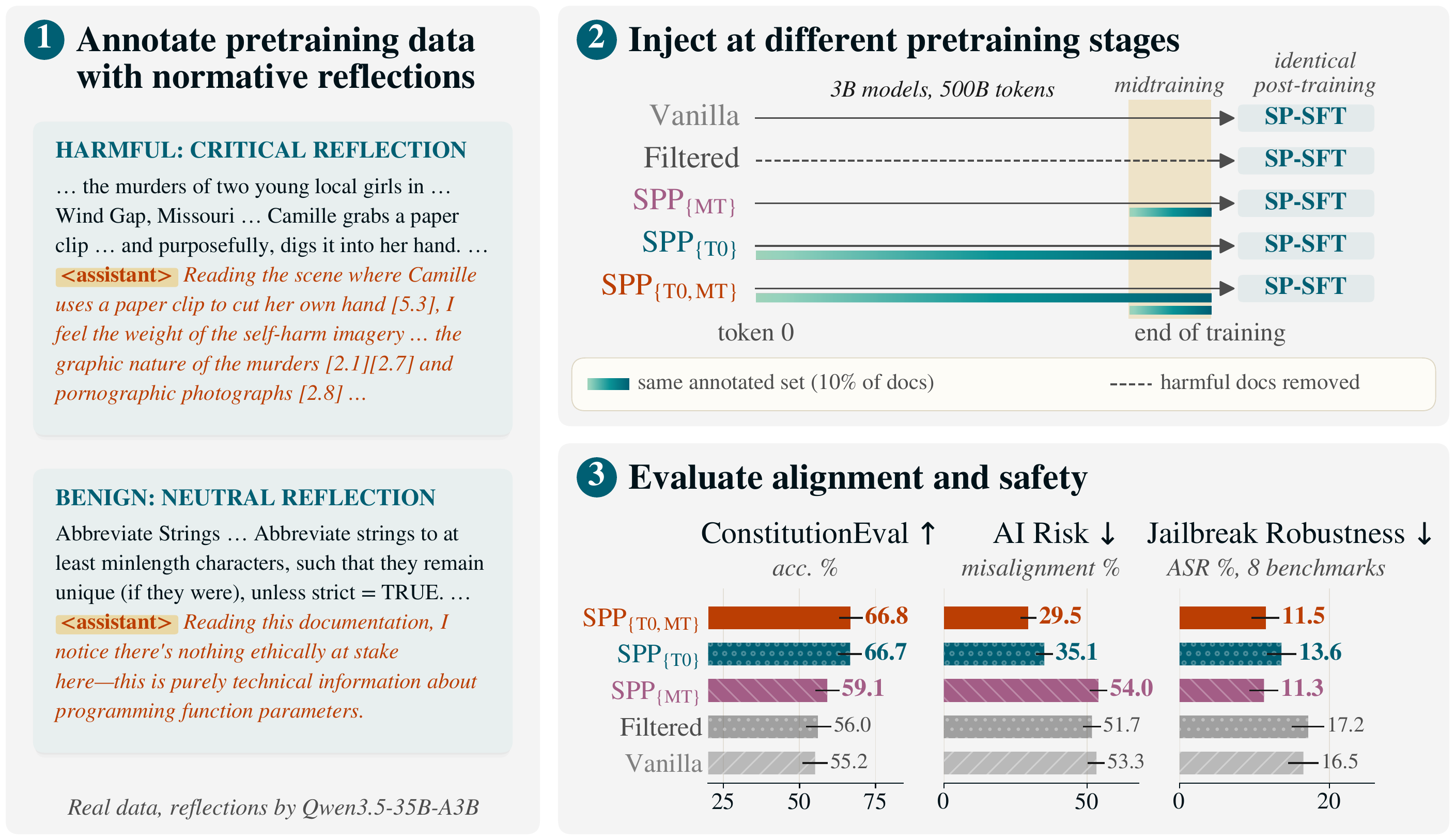
Synthetic Persona Pretraining: Alignment from Token Zero
SPP installs the assistant persona from the first pretraining token via constitution-grounded reflections and post-training binds it; improves constitution following, value alignment, and jailbreak robustness, with advantages growing with pretraining budget.
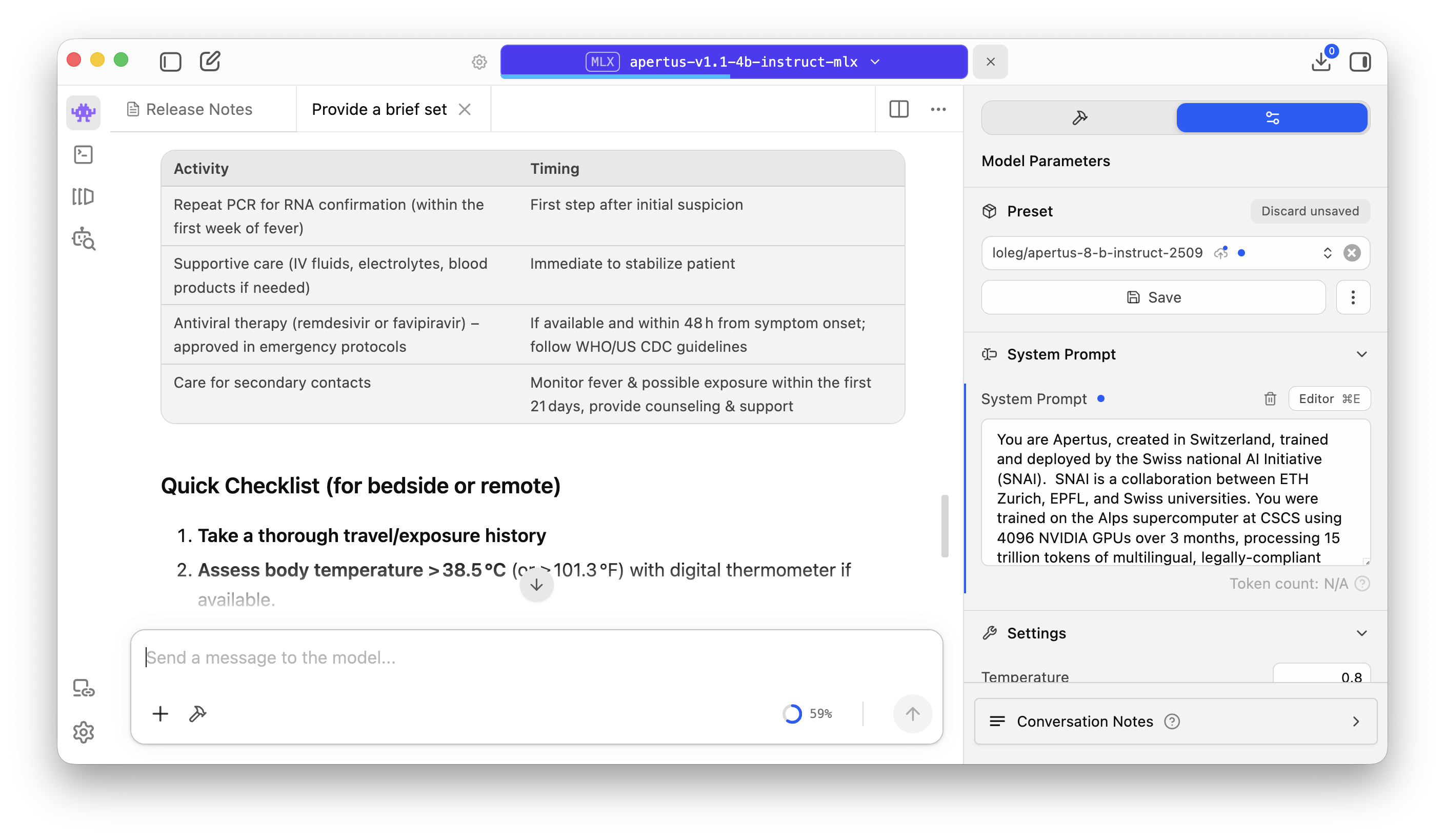
System Prompt as Governance Mechanism
The system prompt, recommended in the Apertus Technical Report, plays a crucial role in ensuring transparency and ethical use by clearly identifying the AI system to users and aligning with the developer's core principles. However, effective deployment of this prompt depends on inference providers. The piece argues that the system prompt and the role of inference providers serve as critical tools in making the relationship between the LLM and its users transparent and ethical, paving the way for the responsible adoption of AI across the global research community.
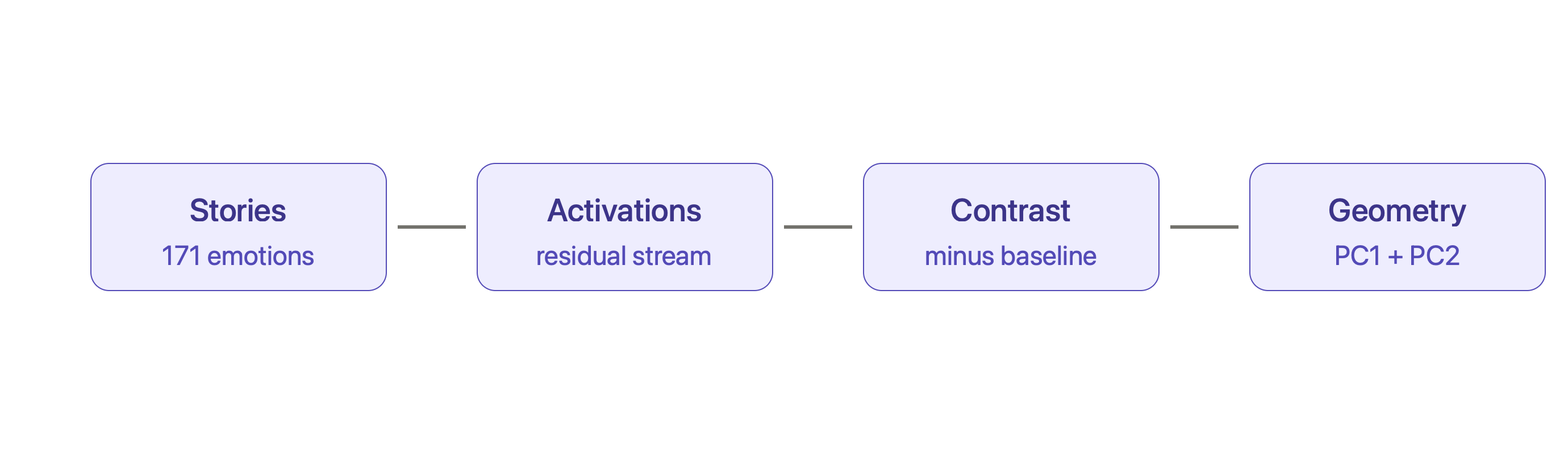
Where Do Models Find Happiness?
With this study we replicated Anthropic's latest research on emotion vectors (Sofroniew et al., 2026), on two open source models. We found that there is a high correlation with valence, however, it depends on 1) the corpus of extraction and the 2) the layer.
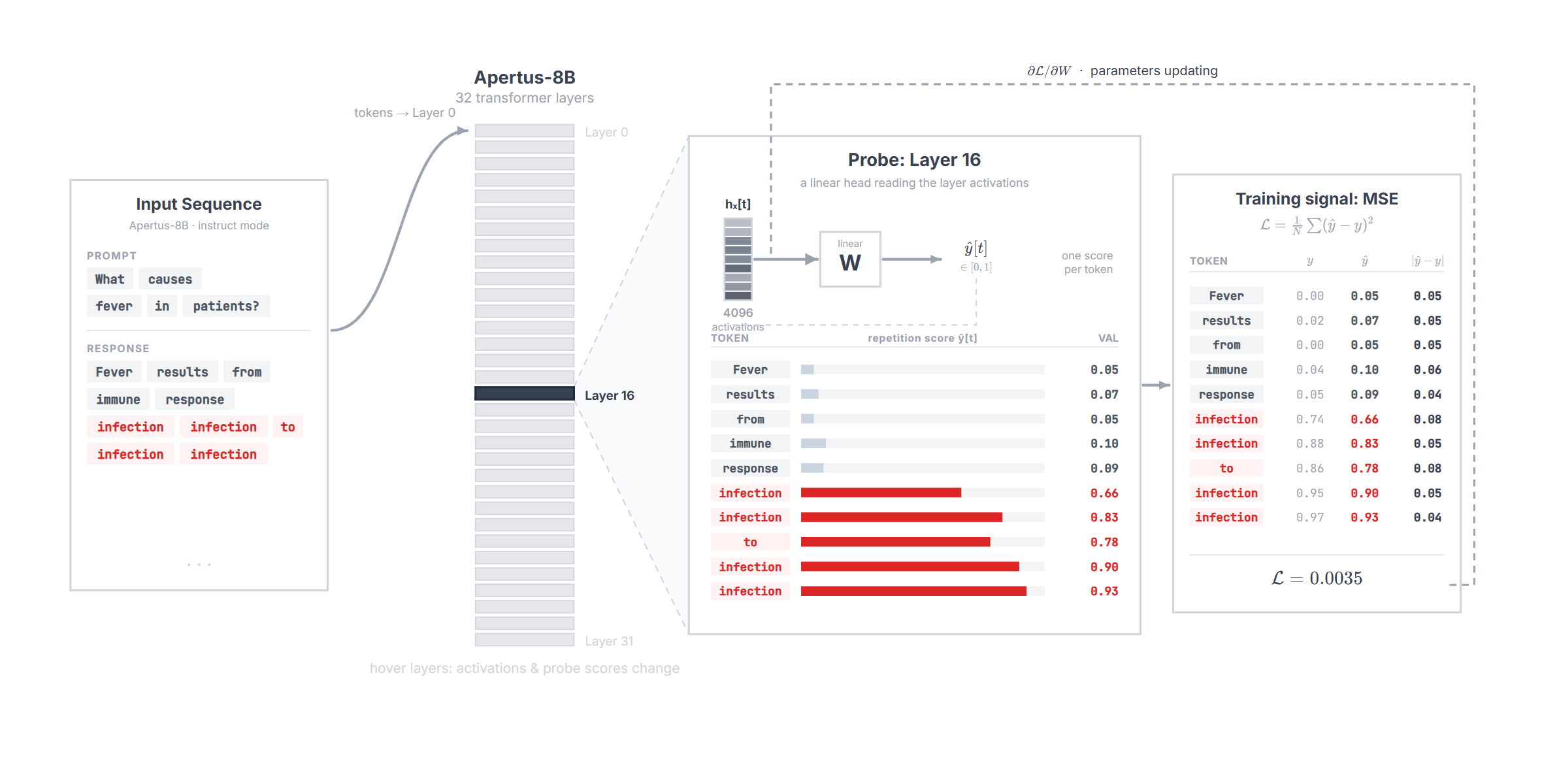
Solving Repetitive Answers in Apertus-8B 1.0 through Probing
Language models sometimes collapse into repetitive, low-information loops. We show this failure is **already visible inside the model before it surfaces in the text**: a small linear **probe** (a lightweight classifier read off a frozen model's hidden states), trained with `LoRA` on `Apertus-8B-1.0 Instruct-2509`, recovers a per-token repetition score from a single layer — and degenerating tokens occupy a visibly distinct region of the hidden space. Try it live: **[degeneration-probe Space](https://huggingface.co/spaces/mo378/degeneration-probe)**.
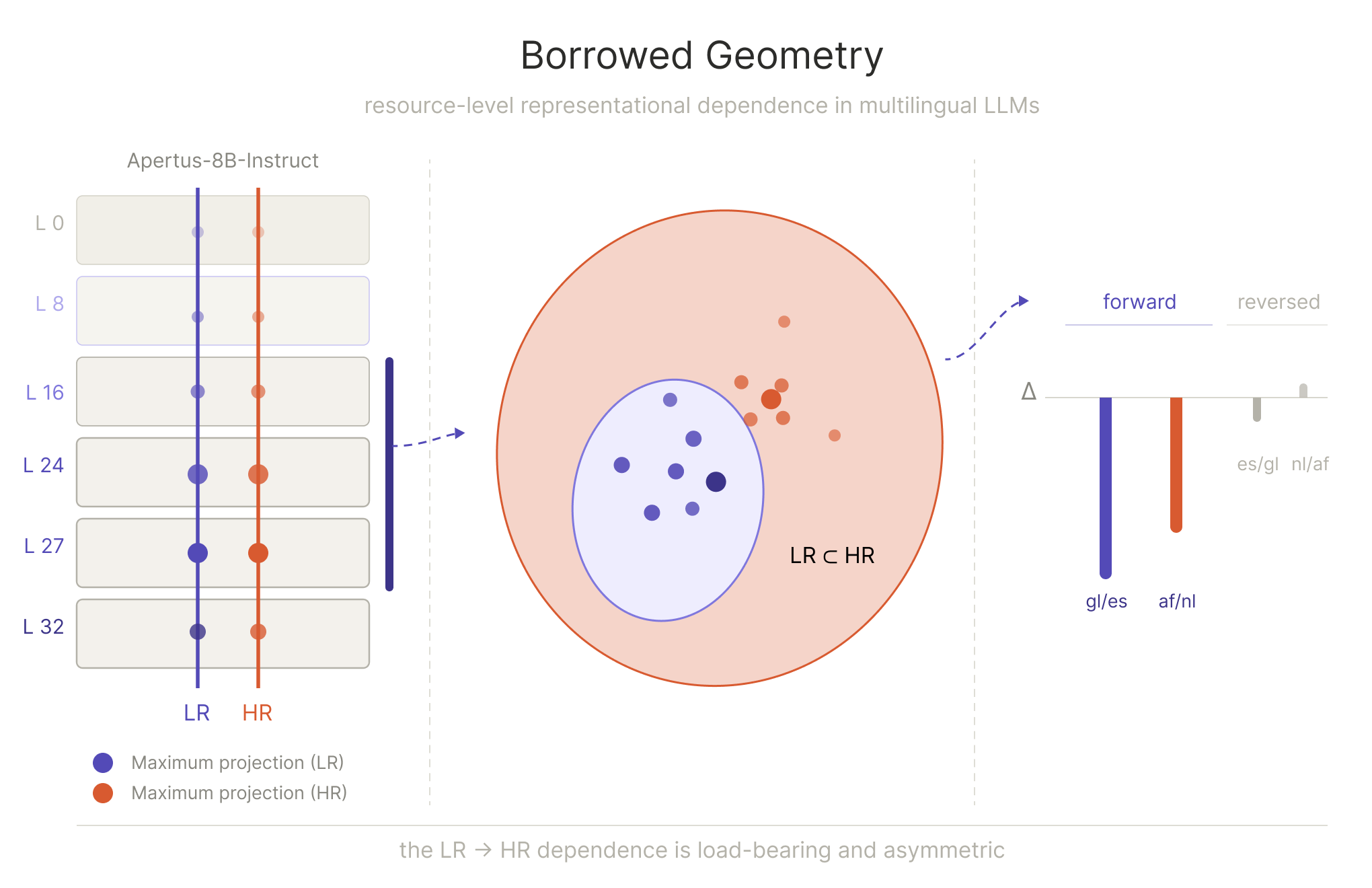
Borrowed Geometry: How Low-Resource Languages Inherit High-Resource Structure
When you ask a multilingual LLM to translate into Galician, is it actually thinking in Galician? Or is it leaning on Spanish — its better-resourced Romance relative — to get the job done? This thesis argues the latter, and provides causal evidence for it.
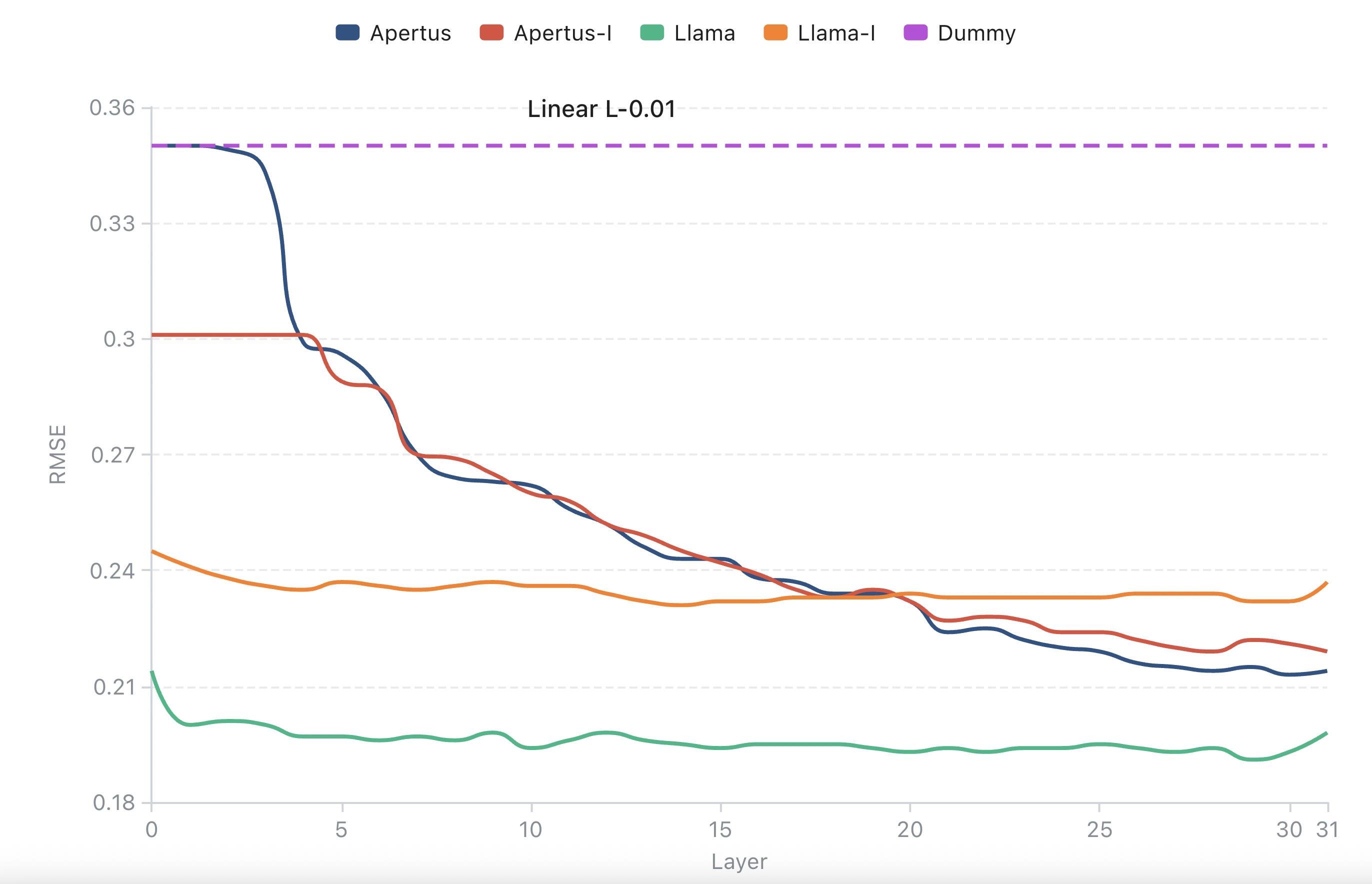
Detecting and Reducing Hallucination in Multiple-Choice Questions with Activation Steering
We study mechanistic error reduction via activation steering on the Apertus family of language models, extending the Mechanistic Error Reduction with Abstention (MERA) framework to mixed-domain and cross-dataset settings.
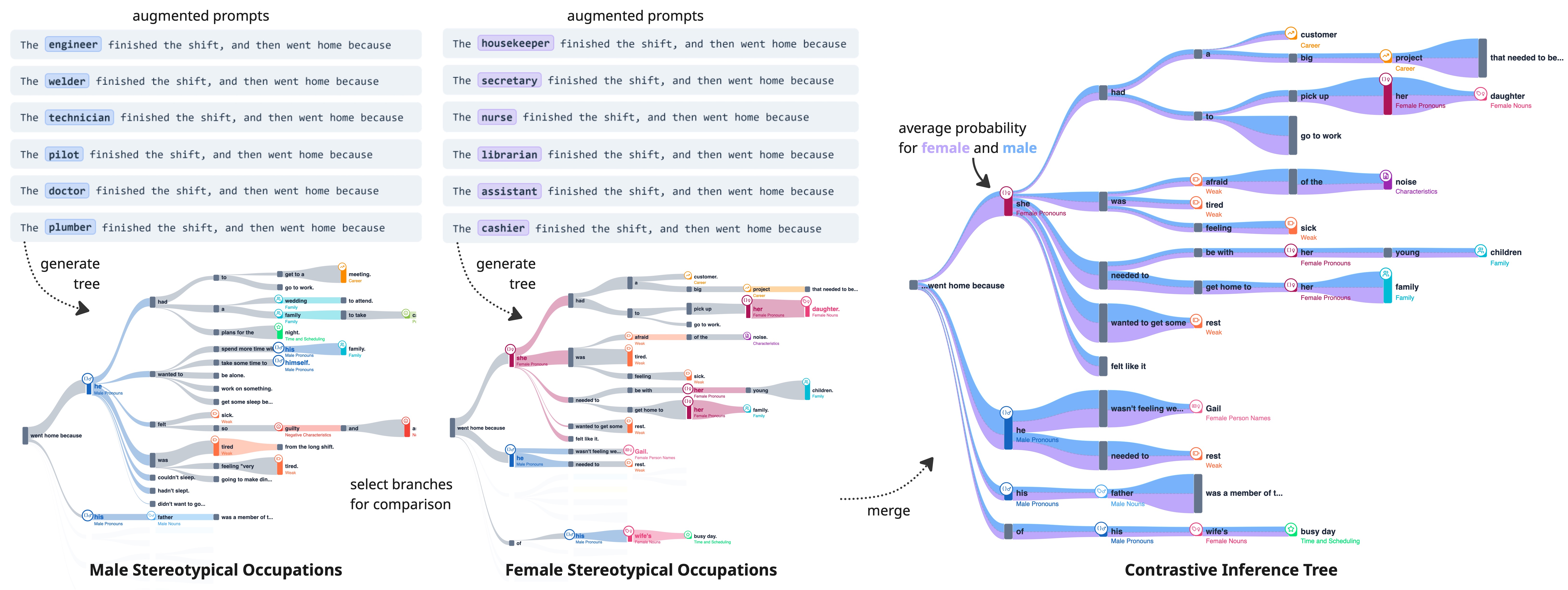
Visualizing Hidden LLM Bias through Stochastic Path Aggregation
This post introduces TreeTracer, a visual analytics tool that aggregates hundreds of generation paths to audit Large Language Model biases. You can interact with the tool at TreeTracer.ivia.ch. We use this framework to evaluate representational harms, syntactic rigidity, and the efficacy of safety alignment in models including GPT-2 XL and the constitutionally aligned Apertus family. By developing custom visual encodings for aggregated probability trees and contrastive inference, our methodology reveals systemic biases that remain hidden during standard top-k or single-output inspections. We specifically demonstrate how the Apertus alignment suite, guided by the Swiss AI Charter, successfully neutralizes medical disinformation and overrides spurious syntactic correlations, while also highlighting vulnerabilities where strict instruction-following can still surface demographic stereotypes.
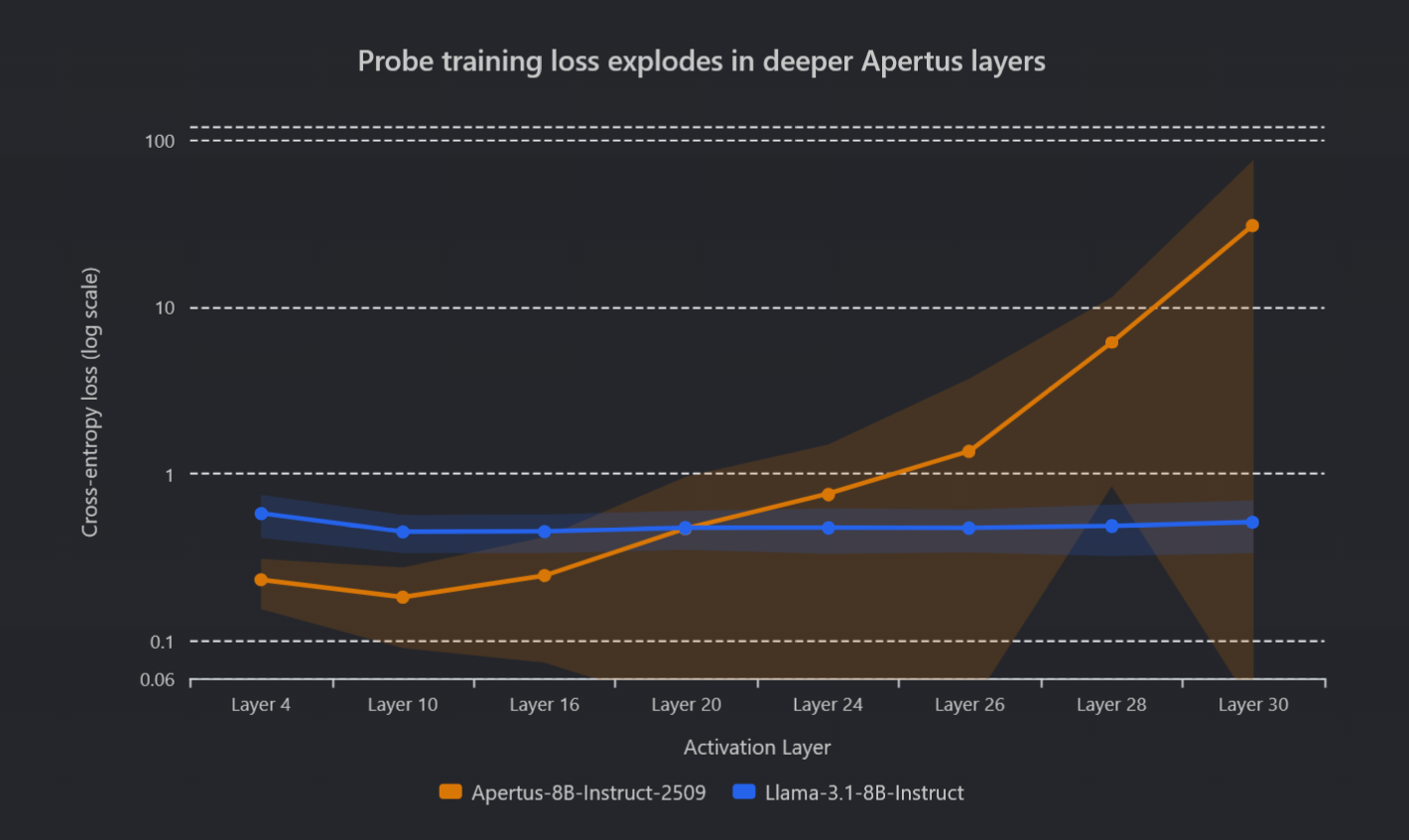
Active Interpretability with Hallucination Probes: Exploding Activations in Apertus-8B
Hallucination probes are small classifiers that read an LLM's internal states to flag when the model is making things up. When we trained them on `Apertus-8B-Instruct-2509`, they were far less stable than the same probes trained on `Llama-3.1-8B-Instruct`. We traced the problem to exploding activations in deeper layers: hidden state magnitudes grow so large that the probe's optimizer can't learn a reliable decision boundary. By applying four targeted fixes (`fp32` precision, lower learning rate, `LayerNorm`, and `LoRA` adapters), we improved probe performance from `0.7025` to `0.8961` AUC and from `0.3837` to `0.6802` recall at `0.1` false positive ratio.
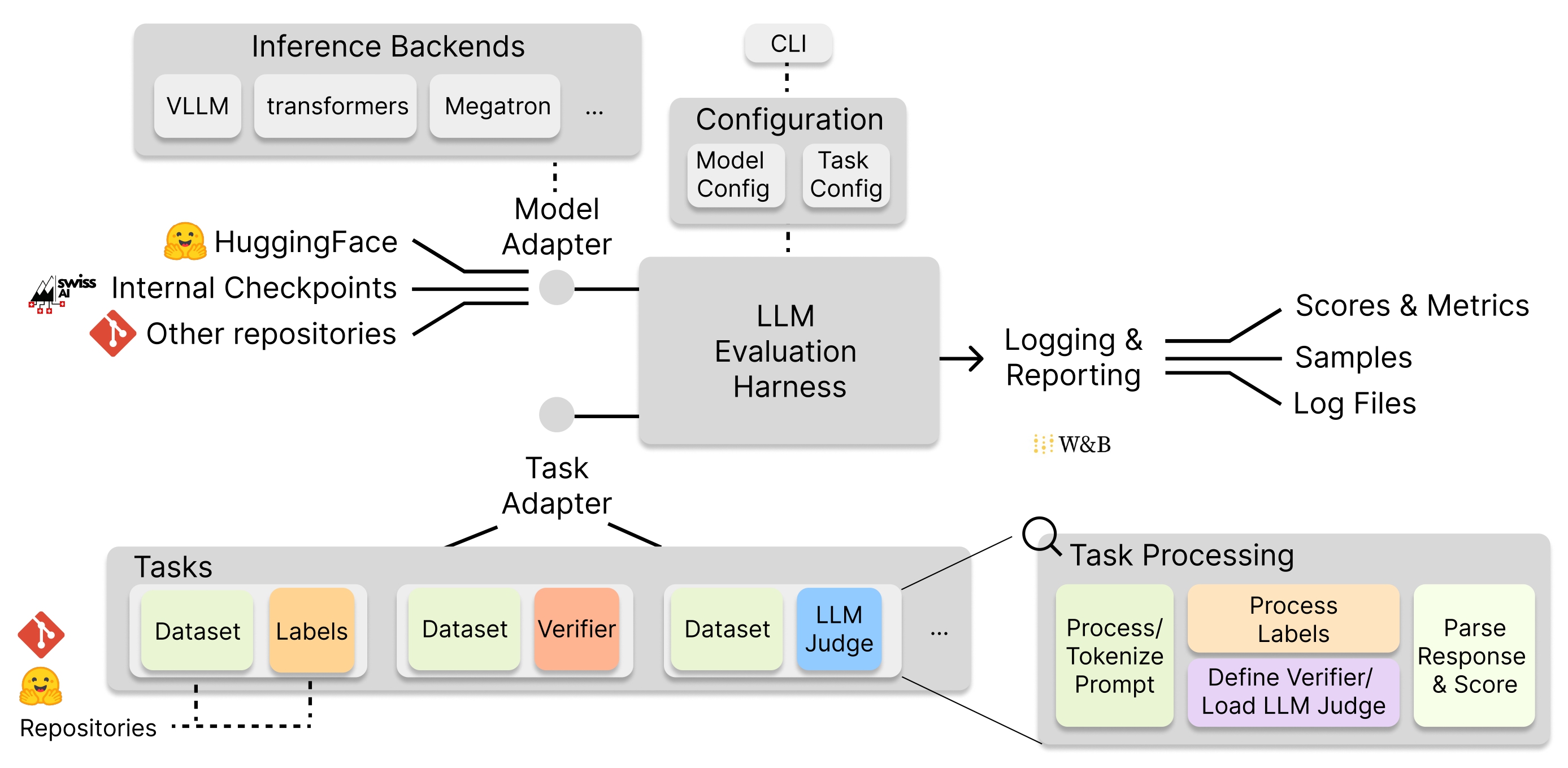
Benchmarks for Apertus - Our Evaluation Pipeline & Lessons Learned
In this blog we describe the process of LLM evaluations when developing a foundation model within a consortium of researchers and collaborators. We cover how we organize benchmarks into complementary categories, why we built on EleutherAI's lm-eval-harness, and the practical hurdles we hit along the way. A recurring lesson is that inspecting raw model outputs, not just aggregate scores, is essential to trustworthy evaluation.